
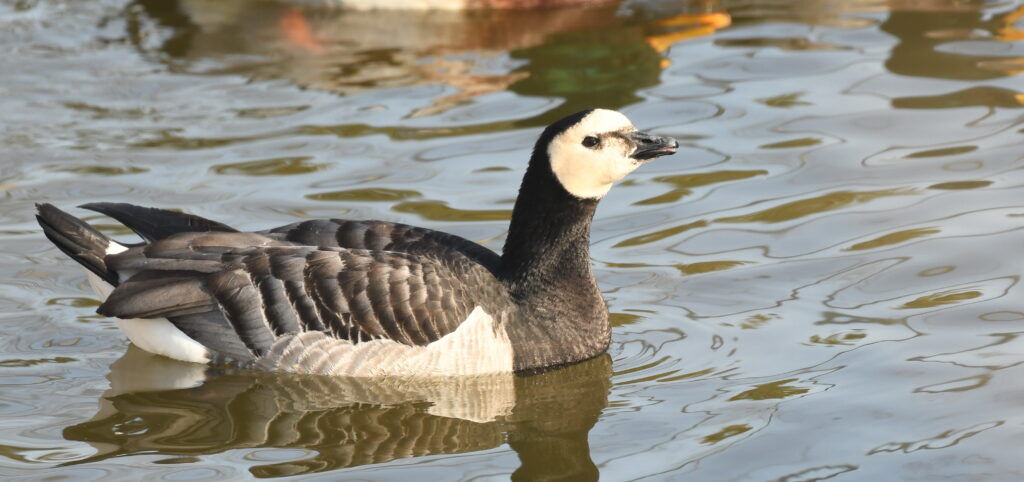
The barnacle goose (Branta leucopsis) belongs to the genus Branta of black geese, which contains species with largely black plumage, distinguishing them from the grey Anser species. It has a white face and black head, neck, and upper breast. Its belly is white. The wings and its back are silver-gray with black-and-white bars that look like they are shining when the light reflects on it. During flight, a V-shaped white rump patch and the silver-gray underwing linings are visible. 
Barnacle geese frequently build their nests high on mountain cliffs, away from predators (primarily Arctic foxes and polar bears), but also away from food. Like all geese, the goslings are not fed by the adults. Instead of bringing food to the newly hatched goslings, the goslings are brought to the ground. Unable to fly, the three-day-old goslings jump off the cliff and fall; their small size, feathery down, and very light weight helps to protect some of them from serious injury when they hit the rocks below, but many die from the impact. Arctic foxes are attracted by the noise made by the parent geese during this time, and capture many dead or injured goslings.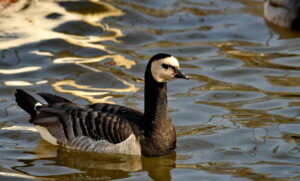
Rare observations in the Danube Delta.
La bernache nonnette (Branta leucopsis) est une espèce de palmipèdes appartenant à la famille des Anatidae et à la sous-famille des Anserinae.
La bernache nonnette mesure entre 58 et 71 cm de longueur et de 120 à 142 cm d’envergure, le dessus de sa tête, son cou et sa poitrine noirs contrastent avec son corps gris. Elle tire son nom du plumage noir qui lui enserre la tête comme un voile de religieuse. Le bec et les pattes sont noirs.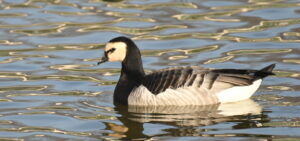
Elle niche traditionnellement dans la toundra des îles arctiques et du Groenland, au Svalbard, en Nouvelle-Zemble et autour de la Mer Baltique. Depuis le début du siècle le nombre de colonies nichant en Finlande, y compris dans la capitale Helsinki, n’a cessé d’augmenter. En hiver elle migre en Grande-Bretagne, en Allemagne et aux Pays-Bas.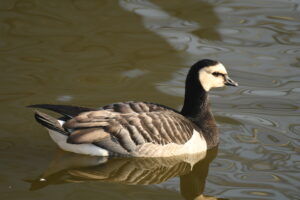
Peu oiseaux vien dans hiver dans la region de delta du Danube avec des autre oises.
Gască călugăriță în timpul sezonului de împerechere poate fi găsită pe stânci și insule arctice, iar în timpul iernii preferă că habitat mlaștini, pajiști inundate și câmpuri agricole. Este o gașcă mică, cu lungimea corpului de 58-70 cm, anvergură de 120-142 cm și o masă corporală medie de 1,7 kilograme. Gâtul și pieptul sunt negre, capul este alb cu un cioc mic și negru, spatele este gri cu dungi albe și negre.
Părțile inferioare sunt gălbui, târtiță este albă, iar în timpul zborului, partea inferioară a aripilor este argintie spre gri. Picioarele sunt negre. Masculul seamănă foarte bine cu femela. Se hrănește cu iarbă, mlădițe și frunze de la diverse plante acvatice, iar în timpul iernii cu cereale.