
La Macreuse brune (Melanitta fusca) est une espèce de canard plongeur marin de la famille des anatidés.
C’est un canard de 51 à 58 cm de long avec une envergure de 80 à 90 cm, pesant entre 1 100 et 2 000 g.
Le mâle est complètement noir avec une petite tache blanche sous l’œil. La base de l’aile est également blanche mais c’est surtout visible en vol. Le bec est noir et jaune orangé. Les pattes sont rouges.
La femelle est brun noir avec des bordures plus claires sur le dos et des liserés blancs sur la poitrine. Son bec est noir. Elle a deux taches blanchâtres sur le côté de la tête.
La Macreuse brune niche dans la toundra ou au bord des lacs glaciaires du grand nord et plus encore dans la taïga. En hiver, elle est présente principalement sur les côtes marines, mais on peut la trouver sur les bords des grands lacs ou des fleuves.
Tres rare dans hiver sur le cote litoral roumain.
The velvet scoter (Melanitta fusca), also called a velvet duck, is a large sea duck, which breeds over the far north of Europe and Asia west of the Yenisey basin.
The lined nest is built on the ground close to the sea, lakes or rivers, in woodland or tundra, and typically contains 7–9 eggs. This duck dives for crustaceans and molluscs.
It is characterised by its bulky shape and large bill. It is the largest scoter at 51–58 cm. The male is all black, except for white around the eye and a white speculum. It has a bulbous yellow bill with a black base. The females are brown birds with two pale patches on each side of the head and white wing patches.
Accidental in winter.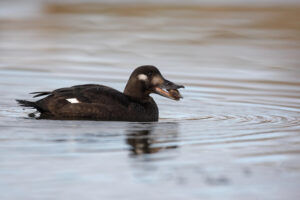
Die Samtente (Melanitta fusca) ist eine Meerente in der Familie der Entenvögel, die sowohl in Eurasien als auch Nordamerika vorkommt. Es werden insgesamt drei Unterarten unterschieden, die sich bei den Männchen vor allem durch die Form des Augenflecks unterscheiden. 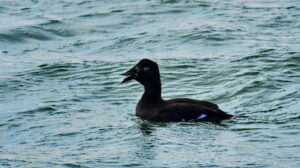 Bei den Weibchen dagegen variiert die Schnabelform und die Stellung der Federspitzen am Schnabel. In Eurasien überlappen sich sowohl die Sommer- wie Winterstandorte mit der sehr ähnlich aussehenden Trauerente (Melanitta nigra).
In Mitteleuropa ist die Samtente an der Nord- und Ostseeküste ein häufiger Durchzüger und Wintergast. Im Binnenland kann sie regelmäßiger und häufiger beobachtet werden als die Trauerente. Im Küstenbereich finden sich auch einige Übersommerer ein.
==========================================================================
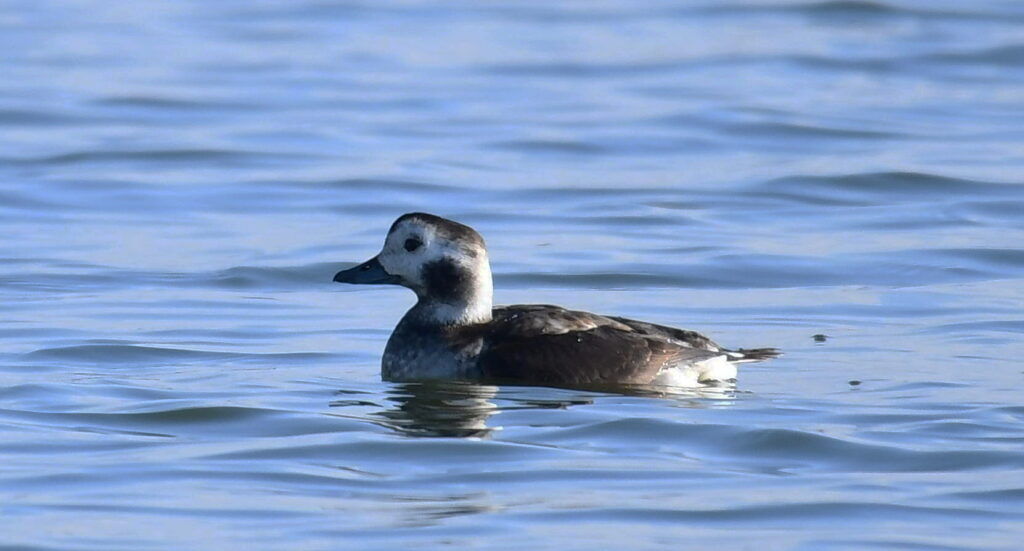
The long-tailed duck (Clangula hyemalis), once known as oldsquaw, is a medium-sized sea duck. It is the only living member of its genus, Clangula.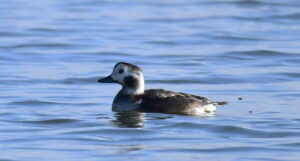
Adults have white underparts, though the rest of the plumage goes through a complex moulting process. 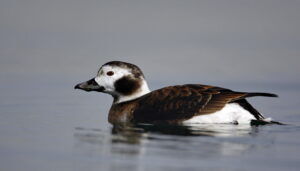 The male has a long pointed tail (10 to 15 cm (3.9 to 5.9 in) long) and a dark grey bill crossed by a pink band. In winter, the male has a dark cheek patch on a mainly white head and neck, a dark breast and mostly white body. In summer, the male is dark on the head, neck and back with a white cheek patch. The female has a brown back and a relatively short pointed tail. In winter, the female’s head and neck are white with a dark crown. In summer, the head is dark.
Some time in winter near the Black Sea litoral.
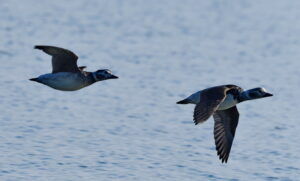
La Harelde kakawi ou Cacaoui (Clangula hyemalis) est une espèce de canard plongeur marin de la famille des anatidés.
Harelde viendrait de l’islandais havela, du danois havlit qui sont les noms de cet oiseau dans ces langues.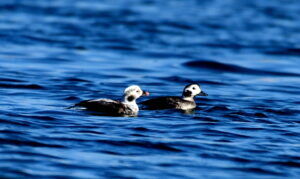
Le mâle est brun-noir en été, en dehors des flancs et d’une tache oculaire, blancs. En hiver, il est de couleur blanchâtre, en dehors de la poitrine, des ailes et de la tache faciale, qui sont noires. En toutes saisons, il possède une longue queue effilée noire.
La femelle a une queue courte, un dos sombre et un ventre blanc.
Suivant dans automne – hiver sur le bord de la mer Noire.