
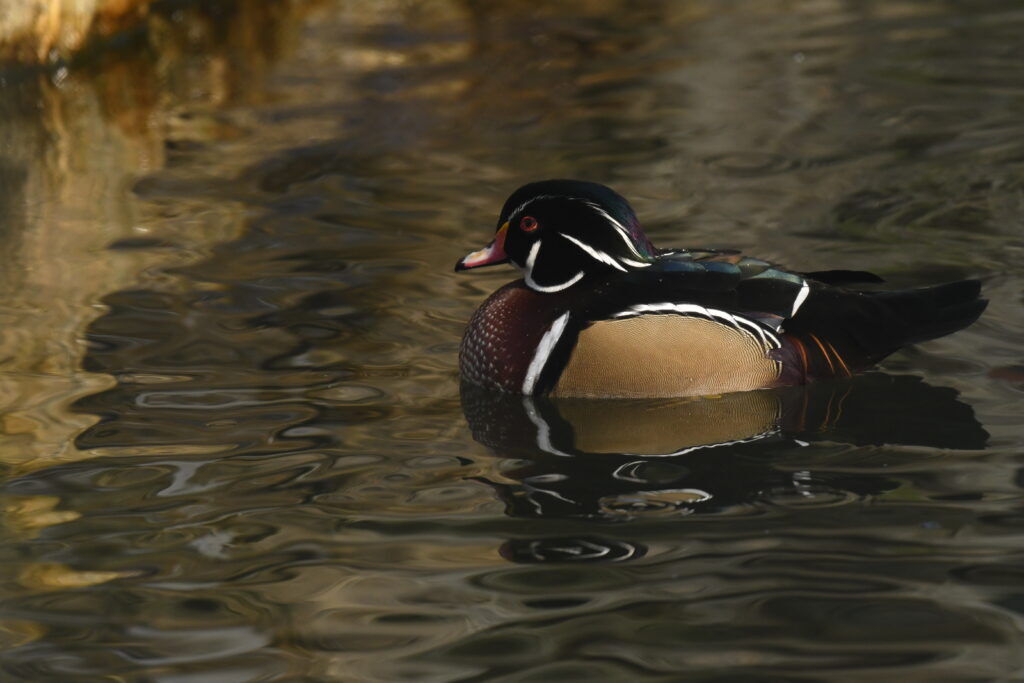
In this post, I have gathered a few duck species that we encounter less frequently in the Danube Delta.
These are species that typically arrive here in winter—especially during years when the entire continent experiences cold winters with heavy snowfall.
The wood duck or Carolina duck (Aix sponsa) is a species of perching duck found in North America. It is one of the most colorful North American waterfowl.
The wood duck is a medium-sized perching duck.
The adult male has distinctive multicolored iridescent plumage and red eyes,with a distinctive white flare down the neck. The female, less colorful, has a white eye-ring and a whitish throat. Both adults have crested heads.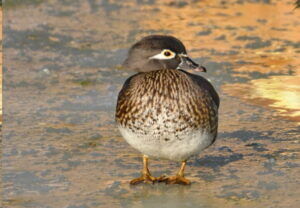
The male’s call is a rising whistle, jeeeeee; the females utter a drawn-out, rising squeal, do weep do weep, when flushed, and a sharp cr-r-ek, cr-e-ek for an alarm call.
Rare observations, for sure birds from zoo or particular colection.
Am adunat in aceasta postare cateva specii de rata cu care ne intalnim mai rar in Delta Dunarii.
Sunt specii care vin aici de obicei iarna si mai ales atunci cand, in tot continentul, avem ierni bogate in zapada si frig.
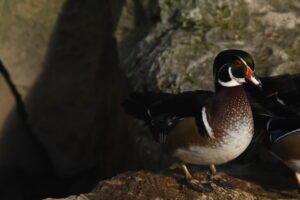
Numita si rata cu ochi de soim.
Rața de pădure poate fi observată în România numai în captivitate în grădinile zoologice și parcurile urbane. Exemplarele observate în libertate provin de obicei din eliberarea intenționată a acestora sau evadarea din captivitate, specia devenind astfel sălbatică și adaptată condițiilor climatului continental temperat. Specia este originară din America de Nord, migrează adesea spre Europa de Vest, respectiv Marea Britanie, Irlanda, Franța, ajunge chiar și în Germania.
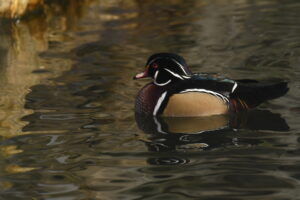 Caracteristic speciei este faptul că prezintă gheare ascuțite cu care se poate cățăra cu ușurință în copaci. Masculul prezintă un penaj multicolor metalizat pe cap și ochii roșii, cu bandă albă pe gât. Femela, mai puțin colorată, prezintă un inel alb în jurul ochilor și gâtul alb. Ambele sexe prezintă creastă pe cap.
==========================================================================
The common scoter (Melanitta nigra) is a large sea duck, 43–54 cm (17–21 in) in length, which breeds over the far north of Europe and the Palearctic east to the Olenyok River. The black scoter (M. americana) of North America and eastern Siberia was formerly considered to be a subspecies. 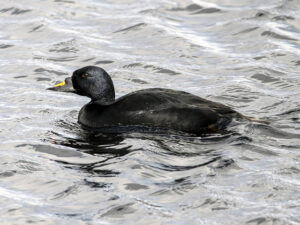
The common scoter is characterised by its bulky shape and large bill. The male is all black with a bulbous bill which shows some yellow coloration around the nostrils. The female is a brown bird with pale cheeks, very similar to female black scoter. This species can be distinguished from other scoters, apart from black scoter, by the lack of white anywhere on the drake and the more extensive pale areas on the female. The black scoter and common scoter have diagnosably distinct vocalisations.
La Macreuse noire (Melanitta nigra) est une espèce de canards plongeurs marins de la famille des anatidés. Le dimorphisme sexuel est prononcé chez cet oiseau, le mâle étant entièrement noir, avec une tache jaune orangé sur le bec, la femelle et les jeunes sont brun clair, avec les côtés du cou et de la tête plus pâles.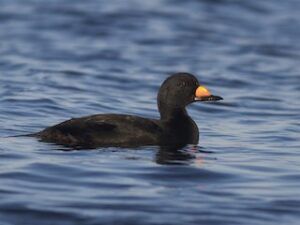
La Macreuse noire hiverne en bandes et revient en mai sur ses aires de nidification où elle se reproduit sur les lacs, dans les roselières ou dans la toundra.
La Macreuse noire plonge pour se nourrir. Son alimentation comprend principalement divers invertébrés où sont prédominants crustacés et mollusques, ainsi que vers et insectes, régime parfois complété à l’aide de petites pousses végétales ou de plantes aquatiques.
=====================================================================================