
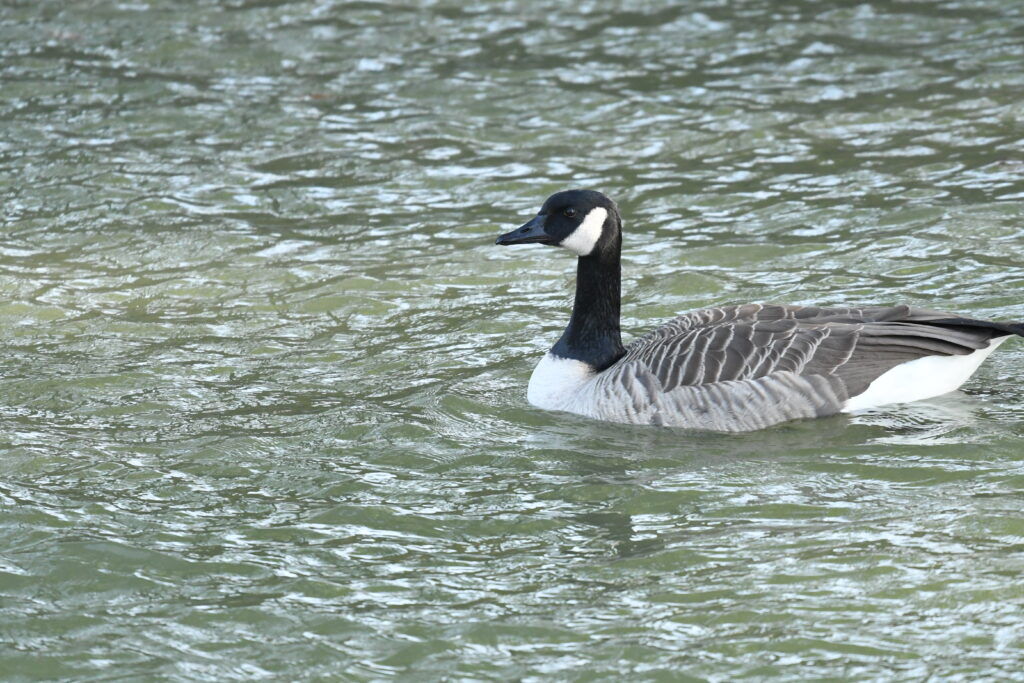
Canada geese are primarily herbivores, although they sometimes eat small insects and fish. Their diet includes green vegetation and grains. The Canada goose eats a variety of grasses when on land. It feeds by grasping a blade of grass with the bill, then tearing it with a jerk of the head. The Canada goose also eats beans and grains such as wheat, rice, and corn when they are available.
In the water, it feeds from silt at the bottom of the body of water. It also feeds on aquatic plants, such as seaweeds. In urban areas, it is also known to pick food out of garbage bins. They are also commonly hand fed a variety of grains by humans in parks all over America.
Rare bird , normaly with other species og geese.
La Bernache du Canada (Branta canadensis) est une espèce de grands oiseaux de la famille des anatidés. Elle est la plus grande des bernaches, ou oies noires.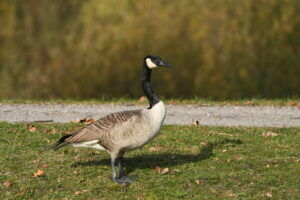
Au Canada, la Bernache du Canada est parfois appelée à tort outarde à cause de sa ressemblance avec l’Outarde Canepetière mâle. Il s’agit pourtant de deux oiseaux totalement différents, l’outarde étant un oiseau terrestre avec des pattes non-palmées et un bec pointu ressemblant à ceux d’une poule alors que la bernache est un oiseau aquatique avec des pattes palmées et un bec rond comme ceux d’une oie. Cette confusion remonte à l’arrivée des premiers colons mais perdure encore aujourd’hui.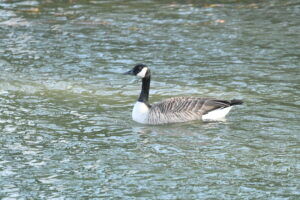
Le cou, le bec et la tête sont entièrement noirs hormis les joues et la gorge qui sont blanches. La queue est noire, le croupion et le bas-ventre blancs, le reste du corps brun-gris avec des liserés plus clairs. Elle mesure environ 75-110 cm de longueur, 127-185 cm d’envergure, le bec mesure 4,1-6,8 cm et elle pèse 2,6-6,5 kg.
Die Kanadagans (Branta canadensis) ist eine Vogelart aus der Familie der Entenvögel (Anatidae) und gilt als die weltweit am häufigsten vorkommende Gans. Ihr ursprüngliches Verbreitungsgebiet ist Nordamerika. Sie ist dort ein Charaktervogel des Tieflandes und brütet an Binnenseen der Prärie- und Ackerbaugebiete. Ihr in charakteristischer V-Formation erfolgender Zug in die Überwinterungsquartiere und die Rückkehr in die Brutreviere im Frühjahr sind in Nordamerika Symbole für den Wechsel der Jahreszeiten.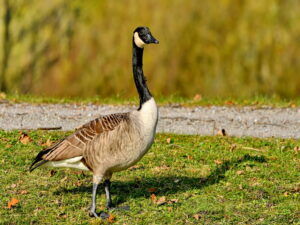
In Europa wurde die Kanadagans zum Teil gezielt angesiedelt. Ein großer Teil der heute vor allem in Großbritannien, Irland, Skandinavien und den Niederlanden existierenden Populationen ist auch auf Gefangenschaftsflüchtlinge zurückzuführen. Seit den 1970er Jahren ist sie auch in Deutschland als Brutvogel vertreten.
Die Kanadagans wird etwas größer als die Graugans und ist damit die größte Gänseart, die in Europa in freier Wildbahn zu beobachten ist.