
Rata sunatoare soseşte la noi în ţară în număr redus, venind din nordul Europei şi Siberiei, unde cuibăreşte şi iernează în apropierea apelor neîngheţate. Alte populaţii trec spre nordul Mării Mediterane şi vestul Europei.
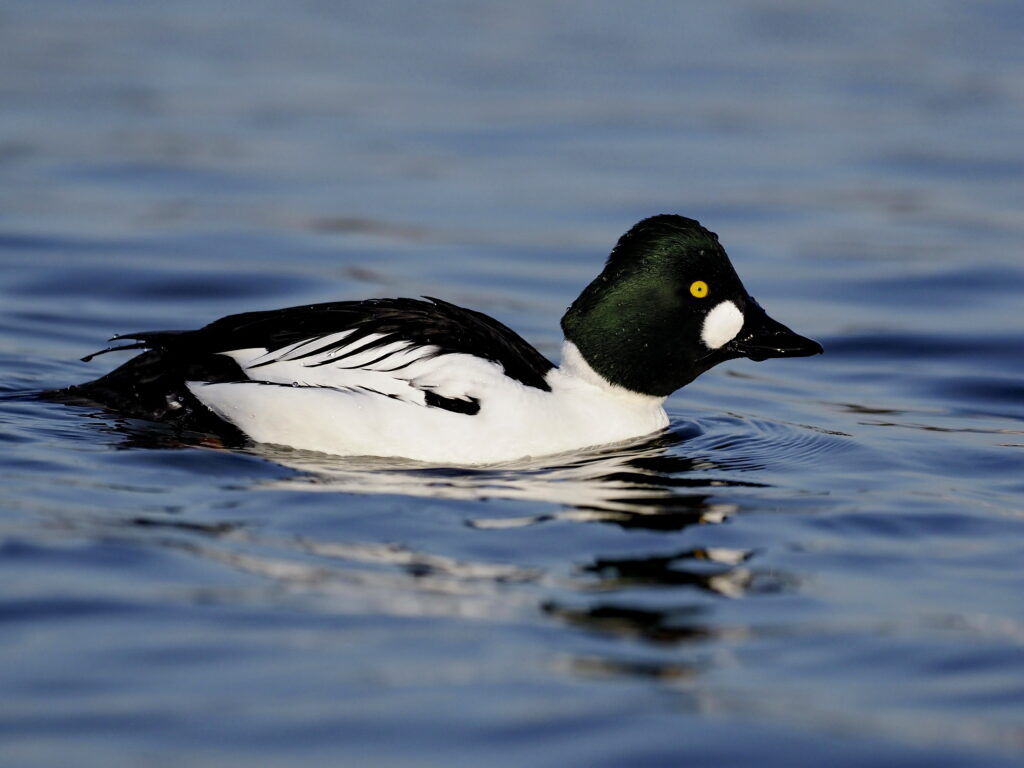
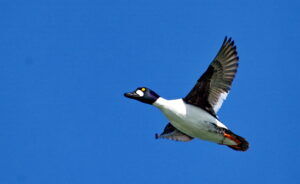
Penajul masculului este negricios pe cap şi spate; la baza ciocului are o pată albă, de aceeaşi culoare fiind şi restul corpului. Femela este de culoare cenuşiu-deschisă, cu capul cafeniu.
La ridicarea de pe luciul apei, masculul scoate un fel de fluierat, în timp ce bate din aripi. Vara se mai întîlnesc unele exemplare rămase atât în Delta Dunării, cât şi în alte bălţi din ţară, fără a se fi dovedit că ar cloci la noi. În trecut este citată că ar fi cuibărit uneori în sălciile scorburoase din lunca şi Delta Dunării. Primăvara se reîntorc în nord.
In Delta Dunarii cuibaresc cateva exemplare in zona coloniei de la Purcelu.
The Common Goldeneye (Bucephala clangula) is a medium-sized sea duck of the genus Bucephala, the goldeneyes. Their closest relative is the similar Barrow’s Goldeneye.
Adult males ranges from 45–52 cm (18–21 inches) and from 888 to 1400 grams (1.9 to 3.1 lbs), while females range from 40–50 cm (16–20 inches) and from 500 to 1182 grams (1.1 to 2.6 lbs). The species is aptly named for its golden-yellow eye. Adult males have a dark head with a greenish gloss and a circular white patch below the eye, a dark back and a white neck and belly. Adult females have a brown head and a mostly grey body. Their legs and feet are orange-yellow.
Their breeding habitat is the taiga. They are found in the lakes and rivers of boreal forests across Canada and the northern United States, Scandinavia and northern Russia. They are migratory and most winter in protected coastal waters or open inland waters at more temperate latitudes. Naturally, they nest in cavities in large trees. They will readily use nestboxes, and this has enabled a healthy breeding population to establish in Scotland where they are increasing and slowly spreading with the help of nestboxes.
They are usually quite common in winter around lakes of Britain and some are being encouraged to nest in nestboxes which are put up to try to have them there all year round.
In winter, common bird on Danube Delta lakes.
Garrot à œil d’or
Il est trapu avec une grosse tête triangulaire et un petit bec. Le mâle a la tête noire avec des reflets vert métalliques et une tache ronde et blanche entre le bec et l’œil qui est jaune, à l’origine de son nom. Le dos et l’arrière sont noirs et tout le reste du corps est blanc. En éclipse, le plumage est semblable à celui de la femelle.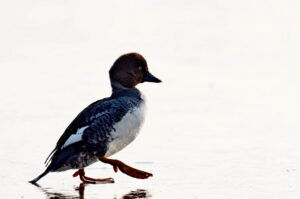
La femelle a une tête brun chocolat, un collier et la poitrine blanchâtre. Le reste du corps est gris-brun.
En vol, mâle et femelle ont une tache blanche sur l’aine.
En Europe, il niche dans les forêts septentrionales de Scandinavie et du nord de la Russie mais également depuis quelques années en France. On le trouve en Asie jusqu’au Kamtchatka.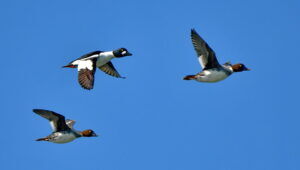
C’est un migrateur, il hiverne au Sud de manière très dispersée.