
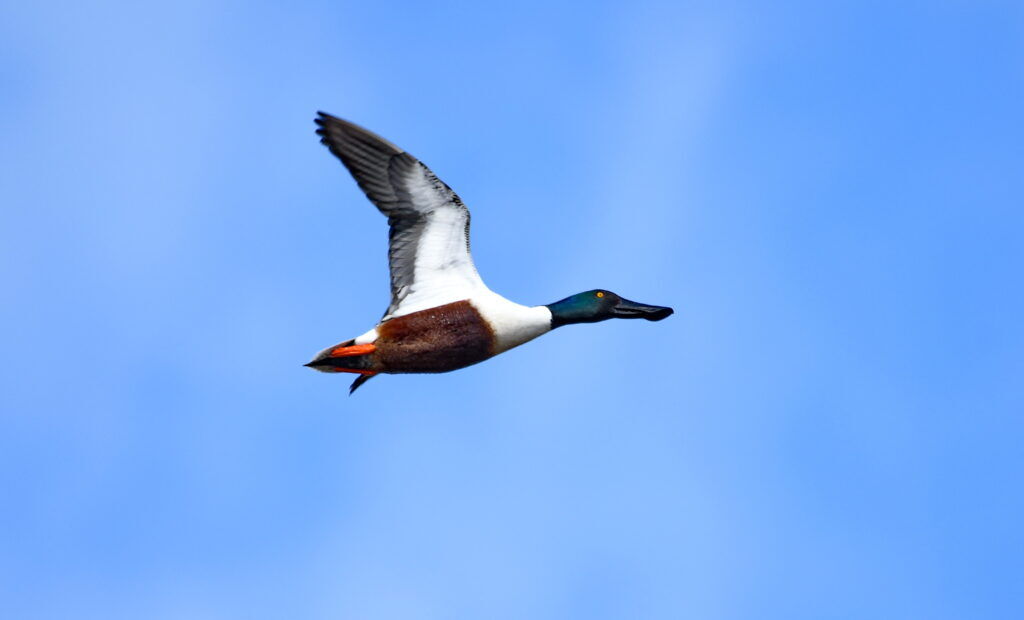
Le Canard souchet (Anas clypeata) est une espèce de canard barboteur qui se reproduit dans les zones septentrionales de l’Eurasie et dans la plupart de l’Amérique du Nord. Il est accidentel en Australie. Habituellement placé dans le genre Anas, cette espèce, assez différente 
du Canard colvert, est placée avec d’autres espèces aux ailes bleues dans le genre Spatula par certains auteurs.
Ce canard de surface, de taille moyenne (44 à 52 cm), se caractérise par un bec massif, allongé, aplati et élargi à son extrémité (en forme une petite spatule). Comme les autres anatidés, l’espèce possède un dimorphisme sexuel qui se traduit par un plumage particulièrement coloré pour les mâles durant la période nuptiale qui court d’octobre à juin.
En vol, il est distinguable par la couleur bleu pâle de l’antérieur de ses ailes sur lesquelles on peu distinguer un miroir vert bordé d’une ligne blanche. Les pattes sont rouges.
Chez le mâle, durant la période nuptiale, la tête est vert bouteille avec des reflets noirs, la poitrine est blanche, les flancs et le ventre sont marron-roux et le haut du dos brun. Les ailes sur le dessus sont gris bleuté avec un miroir vert et la couverture sous-alaire blanche avec le bord postérieur noir. Les iris du mâles sont jaunes toute l’année.

The Northern Shoveler ( Anas clypeata), Northern Shoveller in British English, sometimes known simply as the Shoveler, is a common and widespread duck. It breeds in northern areas of Europe and Asia and across most of North America, wintering in southern Europe, Africa, the Indian subcontinent, Southeast Asia, and Central and northern South America.
This species is unmistakable in the northern hemisphere due to its large spatulate bill. The breeding drake has an iridescent dark green head,white breast and chestnut belly and flanks. In flight, pale blue forewing feathers are revealed, separated from the green speculum by a white border. In early fall the male will have a white crescent on each side of the face. In non-breeding (eclipse) plumage, the drake resembles the female.
The female is a drab mottled brown like other dabblers, with plumage much like a female Mallard, but easily distinguished by the long broad bill, which is gray tinged with orange on cutting edge and lower mandible. The female’s forewing is gray.
They are 19 inches (48 cm) long and have a wingspan of 30 inches (76 cm) with a weight of 600 grams (1.3 lb).
This species is unmistakable in the northern hemisphere due to its large spatulate bill. The breeding drake has an iridescent dark green head, white breast and chestnut belly and flanks. In flight, pale blue forewing feathers are revealed, separated from the green speculum by a white border. In early fall the male will have a white crescent on each side of the face. In non-breeding (eclipse) plumage, the drake resembles the female.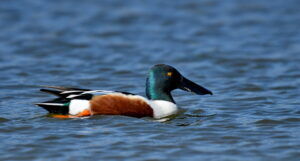
Rata lingurar apare îndeosebi iarna sosind din nordul Europei şi din Siberia, locurile de iernare a speciei fiind ţările din jurul Mării Mediterane şi sud-vestul Asiei pînă-n India. Capul masculului este verde, aripile albe cu albastru, pîntecele roşu; femela este predominant cafenie cu albastru pe aripi. Caracteristic îi este ciocul lung, lăţit la capăt ca o lingură, fapt ce se remarcă uşor chiar la păsările în zbor.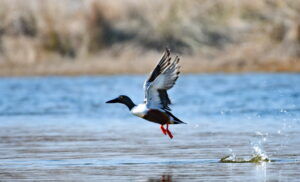
Cuibăreşte relativ rar în ţara noastră, mai ales în Dobrogea, îndeosebi în Delta Dunării, în stufărişuri sau în ierburi dese; preferă ţinuturile apelor salmastre. O gasim totusi iarna – primavara in zona lacurilor limitrofe deltei.
Îşi face cuibul în mai—iunie şi depune 8—10 ouă albe-gălbui sau verzui, pe care le cloceşte femela singură timp de 23—25 de zile.