
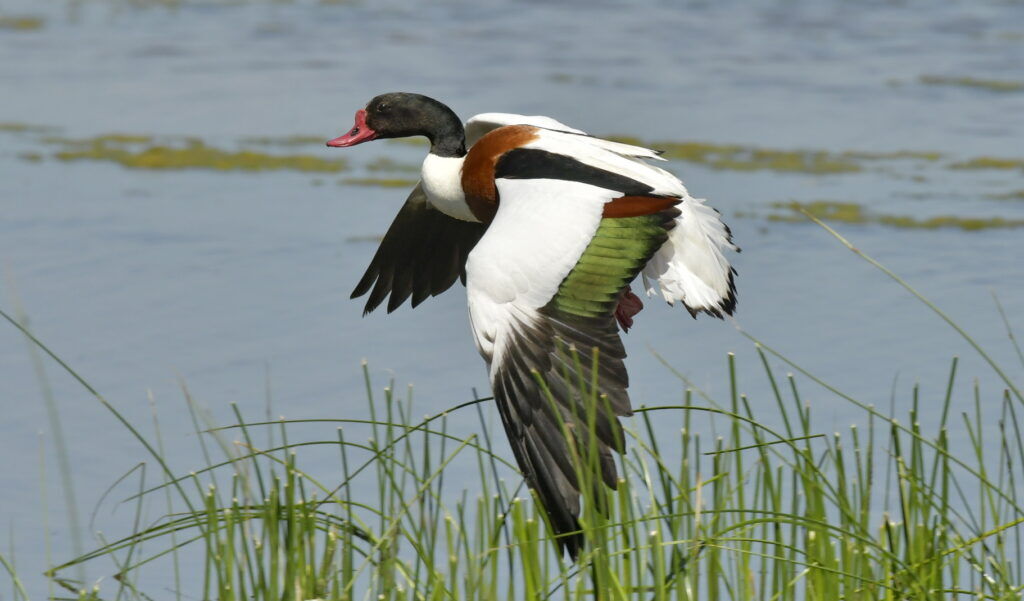
Le Tadorne casarca (Tadorna ferruginea) est une espèce d’oiseau appartenant à la famille des anatidésns l’antiquité (Pline) chenalopex, vulpanser , ou « oie-renard » . Comme les autres espèces du genre Tadorna, il présente des caractéristiques intermédiaires entre celles des oies (faible dimorphisme sexuel entre mâles et femelles, participation du mâle aux soins à la couvée) et celles des canards (morphologie, voix). Cette position intermédiaire est confirmée par les études phylogénétiques récentes.
Il s’agit d’une espèce paléarctique dont la distribution est scindée en deux aires principales, l’une sur les rivages maritimes du nord-ouest de l’Europe et l’autre dans les régions semi arides d’Asie centrale.
Oiseau comune dans Delta du Danube, especial sur la parte ferme .
The Common Shelduck (Tadorna tadorna) is a waterfowl species shelduck genus Tadorna. It is widespread and common in Eurasia, mainly breeding in temperate and wintering in subtropical regions; in winter, it can also be found in the Maghreb.
The Common Shelduck resembles a small short-necked goose in size and shape. It is a striking bird, with a reddish-pink bill, pink feet, a white body with chestnut patches and a black belly, and a dark green head and neck. The wing coverts are white, the primary remiges black, and the secondaries green (only showing in flight) and chestnut. The underwings are almost entirely white.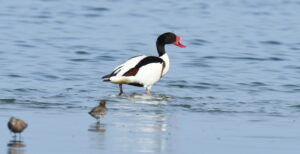
Sexes are similar, but the female is smaller, with some white facial markings, while the male is particularly crisply colored in the breeding season, his bill bright red and bearing a prominent knob at the forehead.
Ducklings are white, with black cap, hindneck and wing and back patches. Juveniles are similarly colored, greyish above and mostly white below, but already have the adult’s wing pattern.
The Common Shelduck is common around the coastline of Great Britain (where it is simply known as Shelduck), where it frequents salt marshes and estuaries. Sightings of this bird are rare in North America and are reported as infrequent visitors to the U.S. and Canada.
The young will dive under water to avoid predators and the adults will fly away from them to act as a decoy.
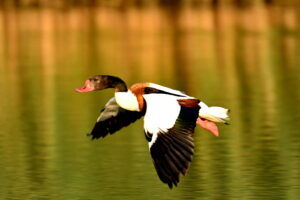
Soseşte primăvara, iar toamna se reîntoarce la locurile de iernare din zona temperată a continentului euroasiatic. În iernile blânde se pot observă exemplare pe lacurile neîngheţate. Cuibăreşte în găuri de pământ sau în vizuinile părăsite ale diferitelor mamifere, de obicei ale vulpilor, pe malurile lacurilor dobrogene, în sud-estul Deltei Dunării că şi pe malul drept al braţului Borcea, lîngă Călăraşi.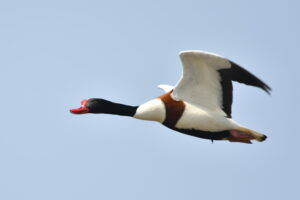
Călifarul alb – protejat în țară noastră din 1955 prin HCM 1625, Călifarul alb este destul de răspândit în Europa. Femela diferă față de mascul doar prin dimensiune (mai mică). Că și Călifarul Roșu, Călifarul Alb este mai apropiat de gașcă , date fiind dimensiunile sale.
Specie comuna in delta, in special pe partea de uscat ce inconjoara marile lacuri.