• English: Greylag Goose / Graylag Goose
• French: Oie cendrée
• German: Graugans
• Spanish: Ánsar común / Ganso bravo
• Portuguese: Ganso-bravo / Greylag Goose
• Italian: Oca selvatica / Oca selvaticagrigia
• Dutch: Grauwe Gans
• Danish: Grågås
• Swedish / Norwegian: Grågås
• Finnish: Merihanhi
• Polish: Gęgawa
• Czech: Husa velká / Husa divoká
• Hungarian: Nyári lúd
• Russian: Серый гусь (Seryy gus’)
• Ukrainian: Сірий гусак
• Japanese: ハイイロガン (Haiirogan)
• Korean: 회색기러기 (Hoesaekgireogi)
• Simplified Chinese: 灰雁 (Huī yàn)
The Greylag Goose (also spelled Graylag in the United States), Anser anser, is a bird with a wide range in the Old World. It is the type species of the genus Anser.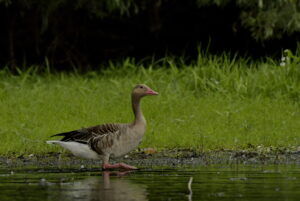
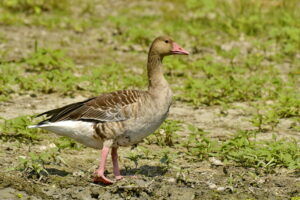
It was in pre-Linnean times known as the Wild Goose (“Anser ferus”). This species is the ancestor of domesticated geese in Europe and North America. Flocks of feral birds derived from domesticated birds are widespread.
The Greylag Goose is one of the species to which the Agreement on the Conservation of African-Eurasian Migratory Waterbirds (AEWA) applies.
Within science, the greylag goose is most notable as being the bird with which the ethologist Konrad Lorenz first did his major studying into the behavioural phenomenon of imprinting.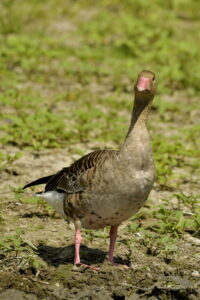
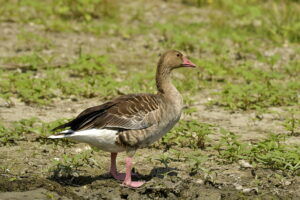
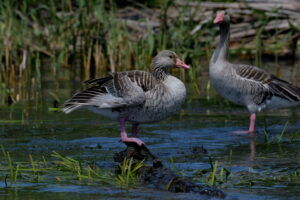
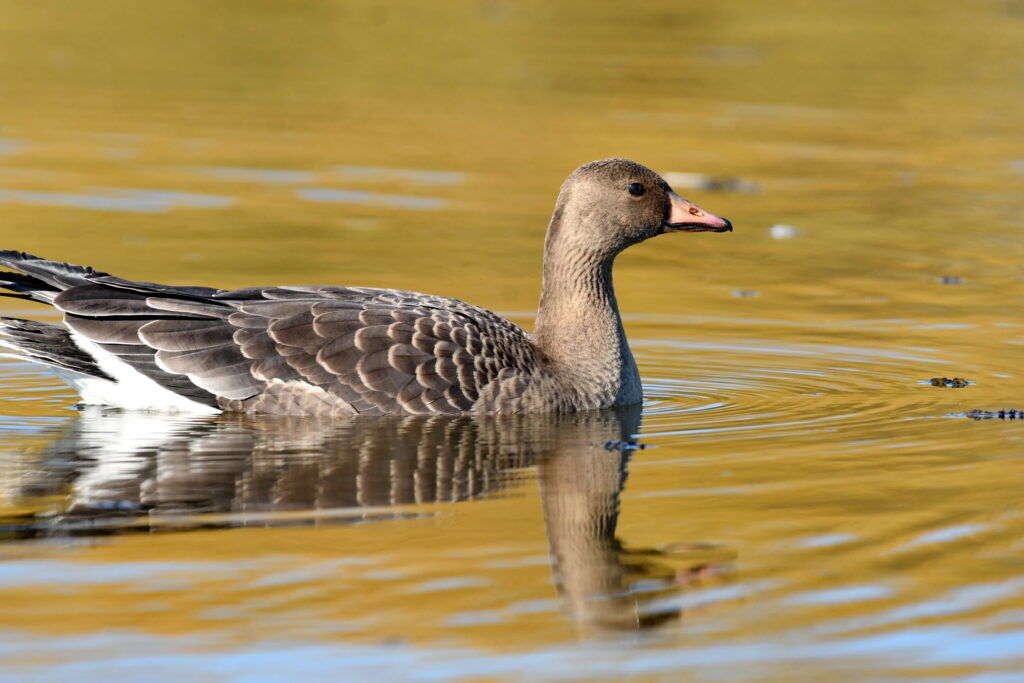
The plumage of the Greylag Goose is greyish-brown, with a darker head and paler belly with variable black spots. Its plumage is patterned by the pale fringes of its feathers. It has a white line bordering its upper flanks. Its coverts are lightly coloured, contrasting with its darker flight feathers. Juveniles differ mostly in their lack of a black-speckled belly.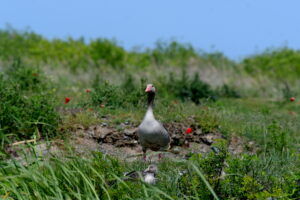
It has a loud cackling call, HOOOOOONK!, like the domestic goose.
This species is found throughout the Old World, apparently breeding where suitable localities are to be found in many European countries, although it no longer breeds in southwestern Europe. Eastwards it extends across Asia to China. In North America there are both feral domestic geese, which are similar to greylags, and occasional vagrants.
In Great Britain their numbers have declined as a breeding bird, retreating north to breed wild only in the Outer Hebrides and the northern mainland of Scotland. However during the 20th century, feral populations have been established elsewhere, and they have now re-colonised much of England. The breeding habitat is a variety of wetlands including marshes, lakes, and damp heather moors.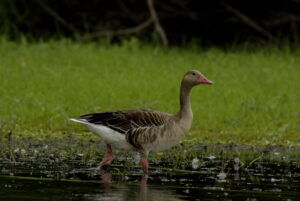
In Norway, the number of greylag geese is estimated to have increased three- to fivefold during the last 15–20 years. As a consequence, farmers’ problems caused by goose grazing on farmland has increased considerably. This problem is also evident for the pink-footed goose.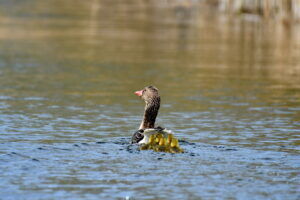
Behaviour
The geese are migratory, moving south or west in winter, but Scottish breeders, some other populations in northwestern Europe, and feral flocks are largely resident. This species is one of the last to migrate, and the “lag” portion of its name is said to derive from this lagging behind other geese.
Very common bird in the Danube Delta.