
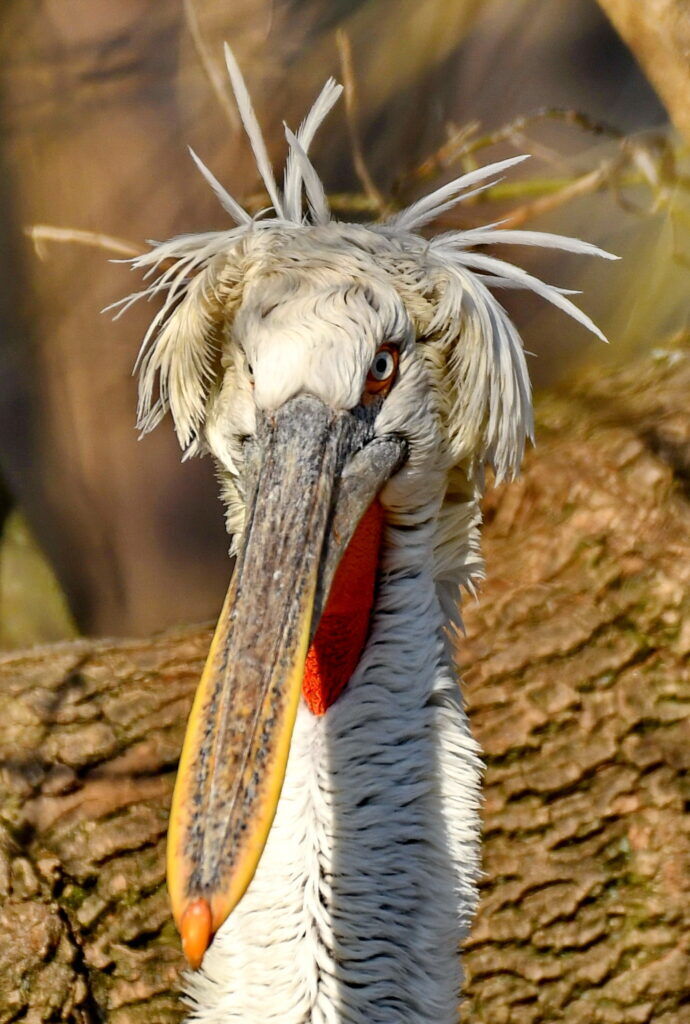
The Dalmatian Pelican (Pelecanus crispus) is a member of the pelican family. It breeds from southeastern Europe to India and China in swamps and shallow lakes. The nest is a crude heap of vegetation. This is the largest of the pelicans, averaging 160–180 cm (63-70 inches) in length, 11–15 kg (24-33 lbs) in weight and just over 3 m (10 ft) in wingspan.

With a mean weight of 11.5 kg (25 lb), it is the world’s heaviest flying bird species on average although large male bustards and swans can exceed the pelican in maximum weight.It differs from the Great White Pelican in that it has curly nape feathers, grey legs and greyish-white (rather than pure white) plumage. It has a red lower mandible in the breeding season. Immatures are grey and lack the pink facial patch of immature White Pelicans.
The latter also has darker flight feathers. This pelican migrates short distances. In flight, it is an elegant soaring bird, with the flock moving in synchrony. The neck is then held back like a heron’s. This pelican feeds mainly on fish, which it scoops along with great masses of water out of the surface of the water. Other small wetlands-dwellers may supplement the diet, including crustaceans and small birds.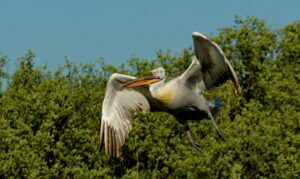
In the Danube Delta we estimate 400 ex. and normaly we could see that bird without problem. Like the White Pelican, this species has declined greatly through habitat loss and persecution[clarification needed]. As of 1994, there are around 1,000 breeding pairs in Europe, most of them in Ukraine, Russia, Greece, Romania, Bulgaria and Albania (Karavasta Lagoon).
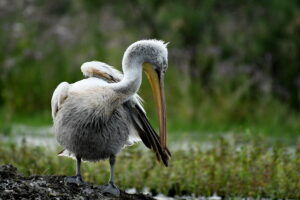
Le Pélican frisé (Pelecanus crispus) est une espèce d’oiseau de la famille des Pelecanidae. Il se reproduit dans le sud-est de l’Europe, en Asie et en Chine, dans les marais et lacs peu profonds. C’est le plus grand des pélicans, 170 cm de longueur, une envergure de trois mètres et un poids atteignant 11 kg, mais aussi la plus rare des sept espèces de pélican recensées dans le monde. Il diffère du pélican blanc par ses pattes grises et un plumage gris-blanc.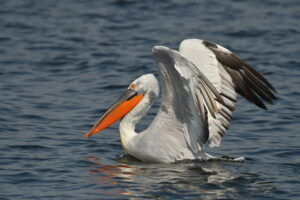
Durant la période de reproduction, sa mâchoire inférieure se colore de rouge. Les pélicans frisés immatures sont gris.
En Europe, le Pélican frisé se rencontre essentiellement dans le delta du Danube où vivraient un millier de couples. Quelques centaines de ces grands oiseaux viennent hiverner au lac Kerkini dans le nord de la Grèce. Cette zone humide, protégée par la convention de Ramsar, est en effet un sanctuaire pour de nombreux oiseaux menacés. Ils affectionnent les touffes de roseaux pour y bâtir leur nid.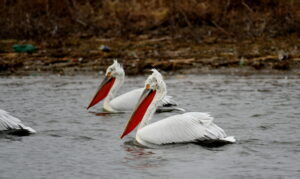 De nombreux individus ont été aperçus dans les alentours du lac Arpi, en Arménie, où ils viennent pour s’y reproduire Le pélican migre sur de courtes distances. Dans Delta du Danube ont trouve aprox. 400 exemplare et c,est un oiseaux qui se peut voire dans des endroits conu de nous.