
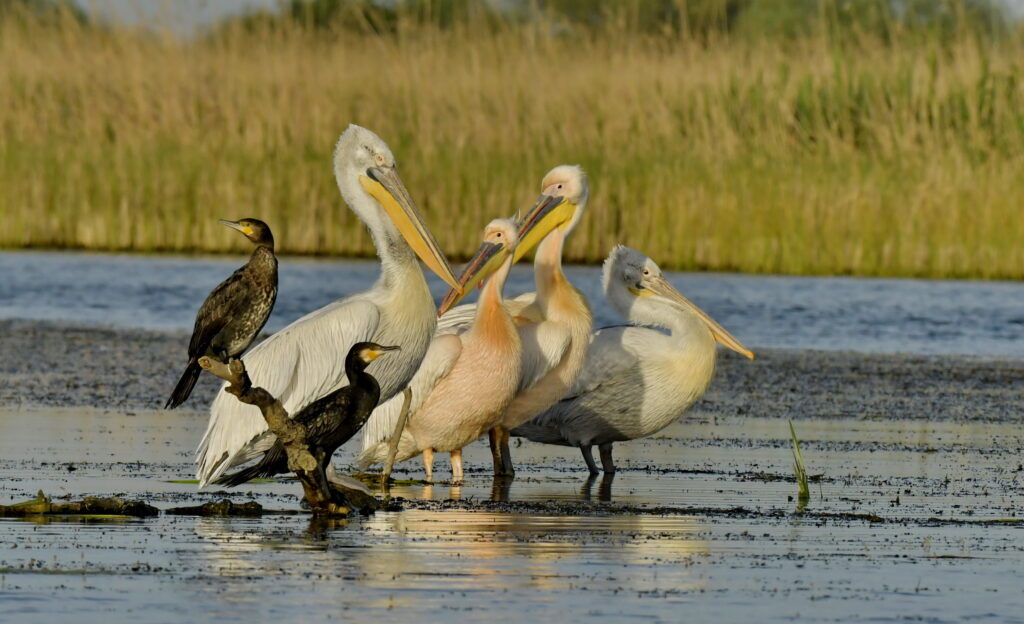
The Great White Pelican, Pelecanus onocrotalus also known as the Eastern White Pelican or White Pelican is a bird in the pelican family. It breeds from southeastern Europe through Asia and in Africa in swamps and shallow lakes.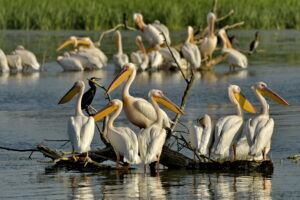
Great White Pelicans are large birds with mass of 10 kg (22 lbs), 160 cm (63 in) long and with a 280 cm (110 inch) wingspan. It differs from the Dalmatian Pelican, the only larger species of pelican, by its pure white, rather than greyish-white, plumage, a bare pink facial patch around the eye and pinkish legs.  Males are larger than females, and have a long beak that grows in a downwards arc, as opposed to the shorter, straighter beak of the female. Immature birds are grey and have dark flight feathers. In flight, it is an elegant soaring bird, with the head held close to and aligned with the body by a downward bend in the neck. In breeding condition the male has pinkish skin on is face and the female has orangery skin.
The Great White Pelican is well adapted for aquatic life. The short strong legs and webbed feet propel it in water and aid the rather awkward takeoff from the water surface. Once aloft, the long-winged pelicans are powerful fliers, however, and often travel in spectacular V-formation groups.  The pelican’s pouch is simply a scoop. As the pelican pushes its bill underwater, the lower bill bows out, creating a large pouch which fills with water and fish. As the bird lifts its head, the pouch contracts, forcing out the water but retaining the fish.
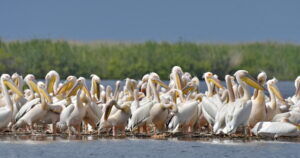
A group of 6 to 8 great white pelicans will gather in a horseshoe formation in the water to feed together. They dip their bills in unison, creating a circle of open pouches, ready to trap every fish in the area. Large numbers of these pelicans breed together in colonies. The female lays 2 to 4 eggs. Nest location varies with some populations making stick nests in trees and others, such as those in Africa, nesting exclusively in scrapes on the ground lined with grass, sticks, feathers and other material. The young are cared for by both parents.
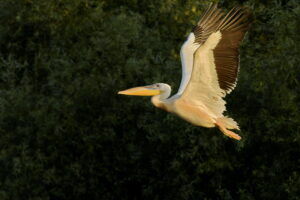 Well scattered groups occur from the eastern Mediterranean through to Vietnam and south to South Africa. Sedentary populations are found year-round in Africa, south of the Sahara Desert although these are patchy, occurring mainly in coastal, estuarine areas and around very large inland water bodies. Migratory populations are found from Eastern Europe to Kazakstan during the breeding season and from northeast Africa through Iraq to north India in the winter. More than 50% of Great White Pelicans breed in the Danube Delta in Romania.
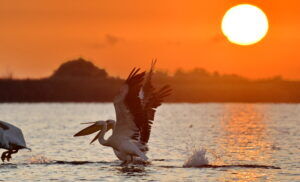
The diet of the Great White Pelican consists mainly of fish. Each pelican needs about 1.4 kg of fish every day. This corresponds to around 28 million kilograms of fish every year consumed at the largest colony of Great White Pelicans, on Tanzania’s Lake Rukwa, with almost 75000 birds. Pelicans are not restricted to fish, however, and are often opportunistic foragers. In some situations they eat chicks of other birds, such as the well documented case off the southwest coast of South Africa.Here breeding Pelicans from the Dassen Island colony predate chicks up to 2 kg from the Cape Gannet colony on Malgas Island.
Great White Pelicans also eat crustaceans, tadpoles and even turtles. They readily accept handouts from humans, and a number of unusual items have been recorded in their diet. During periods of starvation, pelicans also eat seagulls and ducklings. The gulls are held under water and drowned before being eaten headfirst. Pelicans will also rob other birds of their prey.
Today, because of overfishing in certain areas, White Pelicans are forced to fly long distances to find food. Great white pelicans are exploited for many reasons. Their pouch is used to make tobacco bags, Their skin is turned into leather, the guano is used as fertiliser, and the fat of young pelicans is converted into oils for traditional medicine in China and India. Human disturbance, loss of foraging habitat and breeding sites, and pollution are all contributing to the decline of the Great White Pelican.
The Great White Pelican is one of the species to which the Agreement on the Conservation of African-Eurasian Migratory Waterbirds (AEWA) applies.The great white pelican is classified as Least Concern on the IUCN Red List 2006 and is listed on Appendices I and II of the Convention on Migratory Species. It is listed on Appendix II of the Berne Convention on the Conservation of European Wildlife and Natural Habitats and on Annex I of the EC Birds Directive.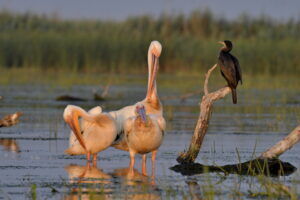
This species is often kept in captivity, in zoos or in semi-wild colonies such as that in St. James’s Park, London. The ancestors of this colony were originally given to Charles II by the Russian Ambassador in 1664 which initiated the tradition of ambassadors donating the birds.
The pelican is the symbol of the Danube Delta, here is the largest colony in the Northern Palearctic, aprox. 22000 specimens. Very easy to notice, in larger or smaller groups, easy to photograph.
Der Rosapelikan (Pelecanus onocrotalus) ist eine Vogelart aus der Familie der Pelikane.
Der Rosapelikan ist ein großer Pelikan mit einer Länge von 160 cm und einer Flügelspannweite von 280 cm. Er unterscheidet sich vom Krauskopfpelikan durch sein weißes (nicht grauweißes) Gefieder mit einem Hauch von Rosa im Brutkleid. Die Schwungfedern dagegen sind schwarz. Um das Auge hat er einen großen rosa Gesichtsfleck. Die Beine sind auch rosa. Die Jungvögel sind grau und haben ebenfalls dunkle Flugfedern.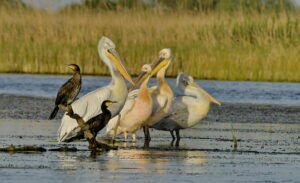
Beim Flug hält er den Kopf zurück wie die Reiher, und die schwarzen Flugfedern werden sichtbar. Er steigt elegant zum Himmel empor und nutzt die Thermik zum Segelflug aus. Der Ruderflug besteht aus langsamen Flügelschlägen.
Der Rosapelikan brütet von Südosteuropa bis Asien in Sümpfen und seichten Seen. Im südlichen Afrika kommt er in Nordbotswana, Westnamibia, an der Westküste Südafrikas, in Ostnatal und Osttransvaal an Süß- und Salzwasser vor.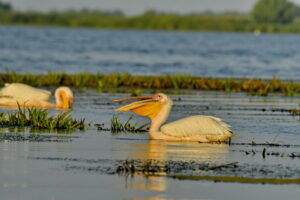
Große Brutgebiete sind in Europa das Donaudelta in Rumänien und in Afrika die Walfischbucht in Namibia. Die europäischen Vertreter der Art überwintern in Nordostafrika.
Abseits der Brutgebiete ist der Rosapelikan ein seltener Gastvogel, in Österreich wurde er jedoch noch bis Mitte des 19. Jahrhundert regelmäßig als Irrgast beobachtet. In neuer Zeit werden einzelne Individuen gelegentlich in Österreich, Belgien, Deutschland, Polen, den Niederlanden und der Schweiz gesehen. Dabei dürfte es sich jedoch in den meisten Fällen um Gefangenschaftsflüchtlinge handeln.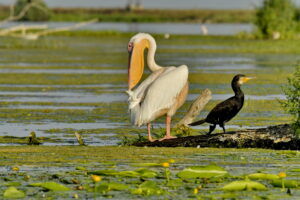
Die Rosapelikane brüten in Kolonien von hunderten bis zu mehreren tausend Paaren. Das Nest des Rosapelikans ist ein unordentlicher Haufen aus Ästen und Zweigen. Schon bei geringsten Störungen verlässt er das Nest, die Jungen flüchten schon mit drei bis vier Wochen bei Gefahr ebenfalls ins Wasser. Mit 14 Wochen werden die Jungvögel selbstständig.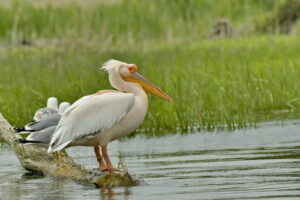
Pelikane fangen Fische mit ihren großen Schnabeltaschen, während sie auf dem Wasser schwimmen. Manchmal bilden sie auch V-förmige Gruppen von 5 bis 10 Tieren, die die Fische zusammentreiben und abwechselnd mit ihrem Schnabel herabstoßen. Aufgrund der Überfischung durch den Menschen haben Rosapelikane vor der Küste Südafrikas begonnen unbewachte Tölpelkücken zu jagen, um ihre eigenen Jungen zu versorgen.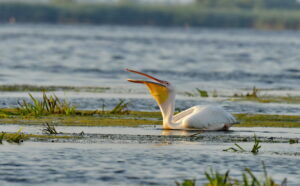
Wie bei den Krauskopfpelikanen hat auch ihre Zahl stark durch den Verlust des Lebensraumes und die Verfolgung durch den Menschen abgenommen, allerdings ist der Bestand nach Daten der IUCN von 2002 mit 270.000 bis 290.000 Tieren noch deutlich größer. Die Art wird daher als „nicht gefährdet“ eingestuft.